In an earlier post (Explosive Decompression at Altitude) the discussion followed that if there is a hole in the aircraft or some other factor that creates a decompression when flying at altitude then first priority is to get down to lower levels where oxygen is richer. People have been asking what happens if you are flying over a mountain range such as the Himilaya’s at the time you “get a hole”. What do you do then? Good question.
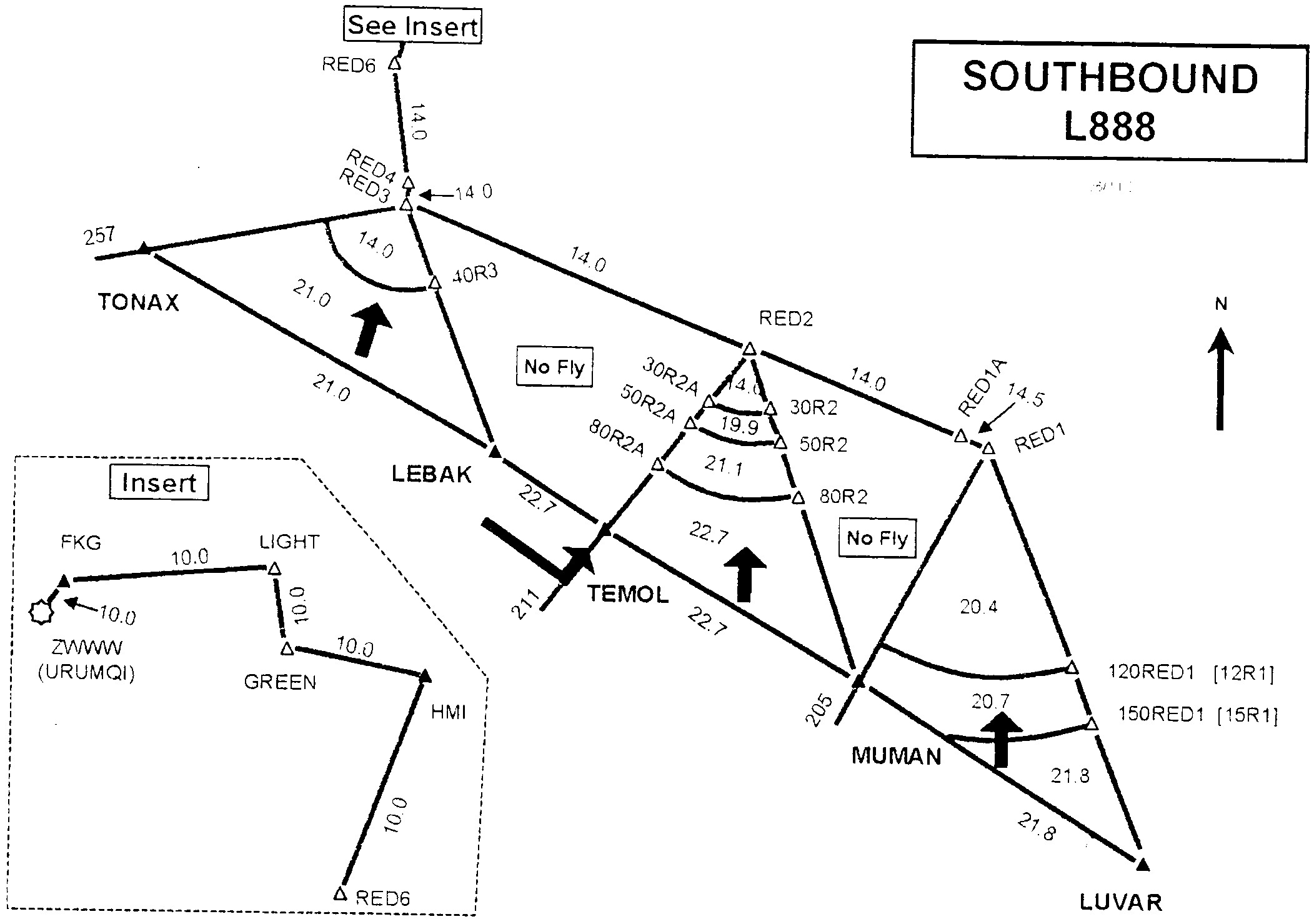
World airline authorities publish what are called “Escape Routes” to solve this predicament. The rationale is that if you need to descend urgently you are going to be constrained by the prevailing topography and how far you can descend. These Escape Route maps are published to assist crews in making judgement on where to fly and at what altitude should the aircraft decompress.
Below is a thumbnail of the Escape Route for China which incidently has some extremely steep/high mountains. Referring to the map it says that if you have a decompression event between TONAX and LEBAK then you can descend to 21,000 feet but no further. You then turn around and fly to 40R3 where you can descend to 14,000. From there you can fly to RED6 then to a place called ZWWW at 10,000 feet. Basically this Escape Route has you flying down valleys. The route doesn’t have a scale on it but the distances are vast. If you have a decompression vent at LEBAK it is about a 3 hour flight to ZWWW!
Thank-you Qantas and Jeppeson for the charts/info