Feed on
Posts
Comments

Winning Credibility

This book is worthy of reading for any entrepreneur. This book is a practical how-to guide for overcoming the hurdles that all entrepreneurs face when starting and growing a business. Serial entrepreneurs Matthew Michalewicz and Zbigniew Michalewicz provide countless out-of-the-box solutions for:

  • Winning that first major client
  • Signing up partners and resellers
  • Building an all-star management team
  • Leveraging new customers from existing customers
  • Impressing the media and analysts
  • Engaging high-profile board members
  • Finding investors who provide more than just money
  • And much more.

Many software company examples are given particularly related to the US. Worth a look at http://www.credibility.com.au/

Tags: , , , , , ,

There is no doubt that opportunities are immense for software enterprises with the likes of web 2.0, SaaS and LAMP. If you are deciding to use Java to design your next killer app what framework would be the most effective to use? That difficult decision fell to our development team recently. No doubt other software development companies are facing the same question.

We looked a number of java web framworks including Spring , JSF, Struts, Tapestry and WebWork. Much of the leg work in finding an answer to the question can be found here.

If you’re having trouble maintaining your in-house Web application framework for Java, you may want to investigate using an enterprise-ready open source framework. Have a look at this whitepaper which explores the open source landscape for Web frameworks in Java.

Another excellent whitepaper can be found here which looks at java Web Framework Sweet Spots.

Tags: , , , , , , ,

One organisation that impresses me is the ANZA Technology Network. Check them out http://www.anzatechnet.com/ ANZA Technology Network is the leading independent organization connecting the Australian, New Zealand and US technology sectors. Through its Gateway to the US Program ANZA has assisted over 175 Australian and New Zealand technology companies as they enter the US market – more than any other non-government organization. In a nutshell ANZAtech helps Australian and New Zealand businesses connect to the US to sell into that market or connect with Angels, VC’s and like to obtain funding.

During 2003 and 2004 we took Data Infinity to the annual ANZAtech “Gateway to the US” conference. The 2004 visit allowed us to forge relationships with the likes of Silicon Valley Bank, angels and VC’s. Prior to the conference in Silicon Valley you undergo a boot camp to prepare you. The boot camp has a panel that scrutinizes your presentation and elevator pitch.

This years ANZA Technology Showcase Conference is in Silicon Valley October 30 – November 1, 2006.

Tags: , , , , , ,

In an earlier post (Explosive Decompression at Altitude) the discussion followed that if there is a hole in the aircraft or some other factor that creates a decompression when flying at altitude then first priority is to get down to lower levels where oxygen is richer. People have been asking what happens if you are flying over a mountain range such as the Himilaya’s at the time you “get a hole”. What do you do then? Good question.

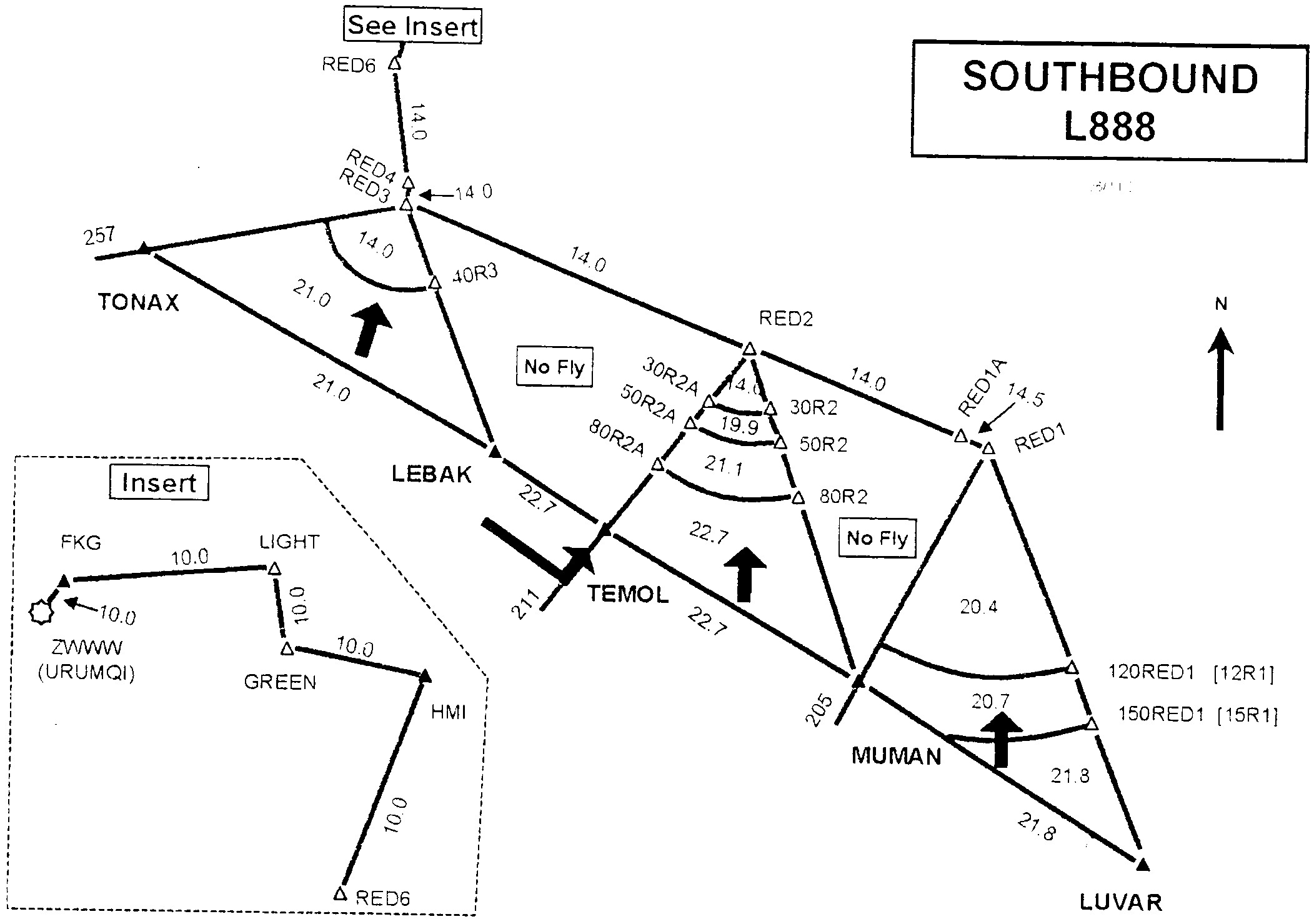
World airline authorities publish what are called “Escape Routes” to solve this predicament. The rationale is that if you need to descend urgently you are going to be constrained by the prevailing topography and how far you can descend. These Escape Route maps are published to assist crews in making judgement on where to fly and at what altitude should the aircraft decompress.

Below is a thumbnail of the Escape Route for China which incidently has some extremely steep/high mountains. Referring to the map it says that if you have a decompression event between TONAX and LEBAK then you can descend to 21,000 feet but no further. You then turn around and fly to 40R3 where you can descend to 14,000. From there you can fly to RED6 then to a place called ZWWW at 10,000 feet. Basically this Escape Route has you flying down valleys. The route doesn’t have a scale on it but the distances are vast. If you have a decompression vent at LEBAK it is about a 3 hour flight to ZWWW!

L888 Escape Route

Thank-you Qantas and Jeppeson for the charts/info

Tags: , , , , , ,

Earthquake In The Air

Back in 2002 I was travelling between Sydney and San Francisco on a United 747-400 when it hit clear air turbulence. The resulting damage was quite severe with many people hurt with broken bones; in fact some people were knocked unconscious. Read the newspaper article here. United Airlines gave me this letter as an apology…

Tags: , , , ,

A number of people have asked me about details of losing pressurisation in flight at altitude. Flight crews are trained to react quickly to situations were there is a loss of presurisation. The human body relies on pressure so that the lungs can work getting oxygen out of the air and into the bloodstream. No pressure, no oxygen transfer. If the aircraft cabin is punctured or the aircaft pressurisation systems fails such that the pressure inside the cabin becomes the same as that outside, this can cause major issues when cruising at altitude. For instance at 35,000 ft a typical person has 45 seconds of useful consciousness. In other words you have just 45 seconds to be able to think and react before you start suffering hypoxia. Hypoxia is another name for altitude sickness. If a person is hypoxic they most likely will feel drunk and believe that everything is fine. If the situation continues it is likely that person will lapse into unconsciousness and, in fact may possibly die. If you are cruising at 40,000 ft you have about 15 secs of useful consciousness. Not much time really. In fact when cruising above 41,000ft it is mandatory for flight crew to be always wearing oxygen masks.

Now you may be saying, well I can just hold my breath at 35,000ft. This will not work as I mentioned before you need pressure on the lungs to be able to be able to oxygenate the blood.

OK. So what happens if you are cruising along at 35,000 ft and a window blows out. This would create what is termed an explosive decompression. There would be a bang and air in the cabin would rush out the hole. It would be very noisy, lots of dust would be kicked up, even foggy. Various gases in your body would be also trying to escape (burp/fart) and it is likely you would have stomach cramps and ear aches. The 747-400 has 3 airconditioning packs that can actually handle a hole the size of a blown out window so it is not THAT big an issue. Never-the-less a lot of things may get sucked out that hole. Hopefully no people. The oxygen maskes would drop automatically. The crew, after putting on their oxygen masks, would immediately initiate a rapid descent. That is idle the engines back, point the nose downward and descent at maximum speed with airbrakes extended. Aim is to get down ASAP to 10,000 ft. Typically it would take 3-4mins to get from 35,000 ft to 10,000 ft. Once at 10,000 ft the oxygen masks can be removed and the crew would fly the aircraft to the nearest airport.

Tags: , , , , ,

Recently I took my kids on a tour of Sydney airport run by a company called Airside Tarmac Tours (http://www.airsidetarmactours.com/) It was all very interesting stuff driving around in a bus inside the airport perimeter fence and seeing how Australia’s busiest airport works.

One thing that really amazed me was this car lot we drove past that had something like 100+ cars in it. As it turns out these cars are ones that have been abandoned at Sydney airport carparks by backpackers and the like. Basically these folks turn up from Europe or whatever, buy a car, drive it around Australia sightseeing then as they leave the country through Sydney airport just dump the car in the airport carpark. Every month the 100+ cars that are abandoned are sold off to car yards.

Tags: , , ,

Wondered why airline food is so bland and tastes like rubber? When cruising at 35,000ft the cabin altitude is at about 8,000ft. Huh? We’ll basically the higher you go the lower the air pressure gets. In fact above 10,000ft the human body starts to have issues such as a reduced level of ability for the lungs to absorb oxygen. Therefore modern aircraft are pressurised so that the air pressure inside the cabin at cruising level is equivalent to say standing on an 8,000ft mountain.

However the humidity inside the cabin is the same as outside and is very low at <1%. It is a very dry atmosphere so the body can quite easily dehydrate particularly if you drink alcohol and coffee on the flight. The human sense of smell requires humidity to work. No humidity, no smell. When you eat food a large portion of the pleasure of eating comes from smelling the food that you are eating. No smelling ability the food tastes bland.

A positive aspect of not being able to detect smells at 35,000ft is that if you have “wind” problems you can merrily release wind and, as long as it is done quietly, no one around is going to know any better. Ditto for smelly feet. Wait till you are at cruising level before taking off those smelly shoes reaking of foot odour.

Tags: , , ,

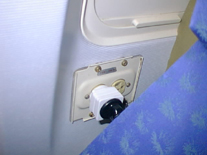
If you are flying in economy class how are you able to get power for your laptop? Most aircraft are equipped with sockets at regular intervals amongst the seating to allow cleaning staff to power their vacuum cleaners (refer image). Laptop power supplies can fortunately handle a broad range of voltages. In fact the mentioned power sockets run off the aircraft 112VAC 400Hz system. Just plug your laptop into one of these and presto! Your powered up able to kill those hours away on long flights doing laptop work. Incidentally I carry a DVD or two to watch on those Pacific Ocean crossing flights rather than be subjected to the airline movie programming.

For the 747-400 row 45 (A or J seat), second seat from the back, works for Qantas.

About John Radge

Tags: , , ,

Must do: LinkedIn

Networking is a key element of the successful software entrepreneur. If you haven’t already done so you should subscribe to one of the major social networking apps for business on the web. Personally I use LinkedIn (http://www.linkedin.com/) and have found it easy to use and effective. LinkedIn caters to business people with both free and fee-based options and has 5 million subscribers. You can view my LinkedIn profile on the links bar as an example.

LinkedIn is a great tool to find people to fill positions. Why would you pay a headhunter a large amount of $ to do a job that you can do for free with LinkedIn.

For me LinkedIn has helped me build business relationships that has led to other significant business. It has been said that LinkedIn is the search engine for business people.

Have a look.

Tags: , ,

« Newer Posts - Older Posts »